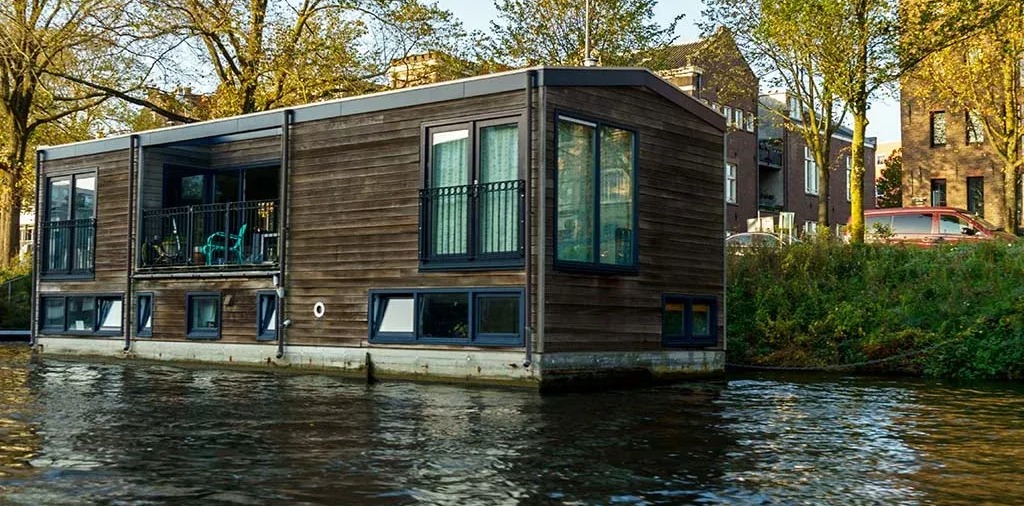
Many people who have never visited Amsterdam may know that the city is built on thousands of wooden piles driven deep into the ground beneath the water. But did you know that some of its residents quite literally live on the water?
Houseboats are an essential part of Amsterdam’s character, adding a unique charm to the city’s picturesque canals—especially along the famous Singel canal, where around 750 floating homes gently bob on the water. In general, there are two main types of floating homes: the houseboat and the ark.
A houseboat is typically a former cargo vessel that has been converted into a comfortable residence, with its old storage hold transformed into living space. An ark, on the other hand, is a floating structure designed from the outset to serve as a home. It is not intended for navigation at all; rather, it is simply a house built on water—much like Noah's Ark.
Houseboats in Amsterdam offer one of the most memorable accommodation experiences, allowing visitors to stay surrounded by calm waters and beautiful canal views. Today, the city is home to more than 1,550 floating residences, some of which are available to rent for a night or several nights.
At Flying Carpet Amsterdam, we organize sightseeing tours that pass by some of the most beautiful floating homes in the Netherlands. If you would like to see them, simply let us know when booking one of our tour packages. Rental prices vary significantly depending on the season and location. During the low season, you may find modest houseboats starting from around €68 per night, while in peak tourist season, luxury floating homes can cost as much as €490 per night.
One amusing story often shared by houseboat residents concerns a nervous tourist visiting Amsterdam for the first time. Eager to experience life on the canals, he booked a stay on a floating home. On his first night, he awoke in terror to the sound of rushing water. Convinced the houseboat was sinking, he leapt out of bed and began shouting for help. Neighbors soon gathered, only to discover that the sound was caused by waves from a passing boat striking the sides of the houseboat. The incident became a humorous tale among local residents and a memorable introduction to canal life for the startled visitor.
Many visitors wonder how these homes remain afloat. The answer lies in their carefully balanced design and the use of buoyant materials. Some are built on large waterproof concrete pontoons that provide excellent stability and support. To prevent drifting, houseboats are secured to steel piles driven into the canal bed or anchored with strong cables attached to the quay or to heavy weights beneath the water. This allows the homes to move gently with the water while remaining firmly in place.
The history of floating homes in Amsterdam stretches back to the seventeenth century. At that time, some people lived aboard boats in the canals, including foreign merchants who sold goods directly from their vessels—sometimes without official authorization. Their relationship with the municipal authorities was often strained, as city officials viewed them as a source of disturbance and unfair competition for land-based traders. Despite these tensions, floating homes remained part of Amsterdam’s urban landscape for centuries.
In the late nineteenth and early twentieth centuries, steel barges gradually replaced wooden sailing ships. Many of the old vessels were purchased and converted into homes. During periods of severe housing shortages, particularly after World War I and World War II, the number of people living on the water increased rapidly. In some cases, several families shared a single boat.
Yet it was not only those in need of affordable housing who embraced life on the water. Wealthier residents were also drawn to the freedom and tranquility of floating homes, which offered an appealing blend of urban living and closeness to nature. Many of these elegant houseboats were moored along the Amstel.
In 1918, regulations were introduced requiring all houseboat and trailer residents to obtain official permits for their places of residence. Children living on boats were required to attend school, and the vessels themselves had to meet specific standards.
Today, living on a houseboat is no longer an inexpensive housing option. The city authorities have frozen the number of mooring permits, which has significantly increased property values. However, living on water no longer necessarily means living aboard a traditional boat. One of Europe’s most sustainable floating neighborhoods is located along the Johan van Hasseltkanaal in Amsterdam-Noord, where approximately thirty modern floating homes rest on specially designed arks.
Houseboats remain one of Amsterdam’s most distinctive features, reflecting the city’s enduring relationship with water, innovation, and adaptability. For visitors, they offer not only a fascinating glimpse into Dutch life, but also a unique perspective on one of Europe’s most enchanting cities.